


Travel Hacks
Discover the smartest ways to build vacation packages. Our data reveals the exact departure days and booking windows to save up to 59% on your next trip.
Apr 22, 2026

Brian Coccaro
Jul 27, 2026
•
4 mins
You compared flights until the fare finally made sense. You found a hotel that fit the plan and the budget. Then you start adding up rideshares for a week of getting around, and the number climbs fast. Airport to hotel, hotel to dinner, dinner to the trailhead an hour away. Every trip is its own fare, and they pile up quickly.
That is why a rental car can be the smarter deal on more trips than people expect, especially when you'd otherwise be calling a taxi or rideshare for every leg of the trip. One daily rate covers unlimited trips, and the savings can be real. A few timing tricks, a smarter pickup spot, and the right vehicle choice can quietly hand you back hundreds of dollars, all while giving you the freedom to go wherever the day takes you.
The good news is that saving on a rental car usually does not come down to luck. It comes down to a few smart choices: booking the right vehicle, comparing pickup locations, sorting by total price instead of headline rate, and checking what coverage you already have before paying for extras.
That comparison looks even sharper when you put a daily rental rate next to a simple airport-to-downtown rideshare run. Using live rideshare fare estimates for round-trip airport and downtown trips in five top car-rental cities, the totals came in at $69.92 in Orlando, $47.94 in Las Vegas, $119.88 in Los Angeles, $97.86 in Atlanta, and $81.88 in Dallas. Against that, Priceline's average compact car rate is $39.02 per day.
That matters because a compact car is not even the cheapest class on the board. If a simple round-trip rideshare can land near or well above a day's compact rate in major markets, the math can swing even harder once you add dinner across town, a hotel change, or a day trip outside the city. For travelers making more than a couple of point-to-point trips, one rental rate can start to look like the smarter deal.
If the goal is to spend less, start here:
Choose an economy, compact, or mini car unless the trip really calls for more space or special handling.
Compare airport and off-airport pickup locations before booking.
Sort by lowest total price, not just the daily teaser rate.
Check prepaid, pay later, loyalty, and bundle options.
Confirm your existing insurance and credit card coverage before adding extra protection.
Bring your own car seats (airlines will usually check these for free)
Those five moves do most of the heavy lifting.
A rental car makes the most sense when you need flexibility and when the trip involves more than a couple of simple point-to-point rides. If the plan includes multiple stops, a day trip outside the city, a family schedule, or travel between towns, the value adds up fast. If you have a kitchen in your hotel or vacation rental and you plan to shop at a grocery store for the week, a rental car saves on delivery fees or another two rideshare fares.
That flexibility matters in places where public transportation is limited or where the best parts of the trip are spread out. A rental car lets you travel on your own clock, not a bus schedule. It also makes group travel simpler because one booking can cover everyone instead of splitting up and paying for separate rides.
Booking a rental car is straightforward on Priceline. Enter the destination and dates, compare available vehicles, and review pickup locations before deciding. If the trip still needs another opinion, Penny can help with trip-planning ideas and car selection.
The bigger point is this: once a car makes sense for the trip, the savings come from how you book it.
The cheapest rental car is usually intuitive. Smaller vehicles tend to win on price, and the pricing breakdown below makes that clear:
Vehicle type | Average cost per day |
Mini car | $25.31 |
Economy crossover | $35.52 |
Compact car | $39.02 |
Economy car | $40.18 |
Mid-size car | $40.94 |
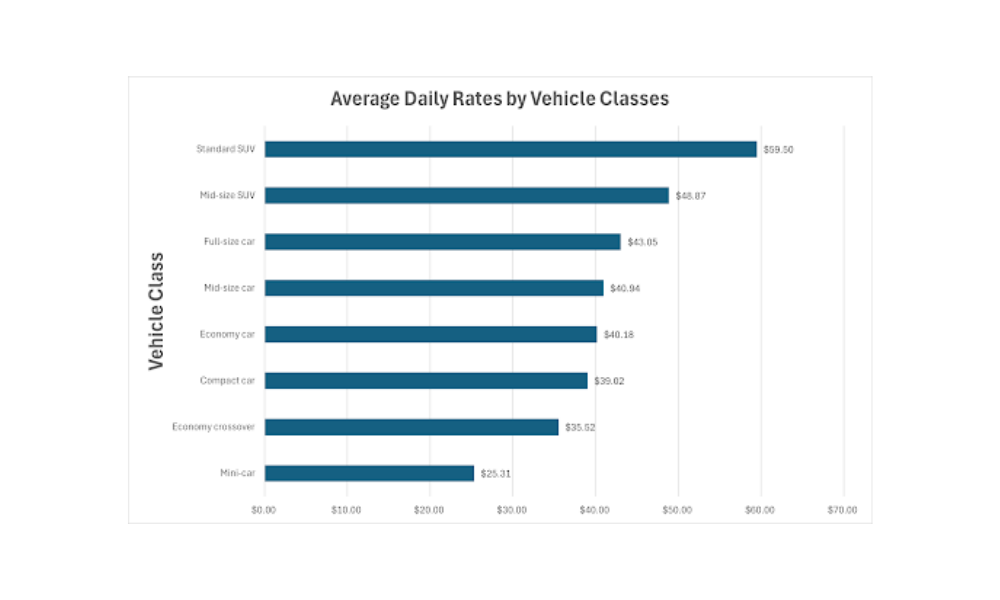
From there, the costs rise with size and flexibility. Full-size cars, mid-size SUVs, and standard SUVs usually cost more than a mini, so it helps to match the car to the actual trip rather than the imagined one.
Here is the practical way to think about it:
For city driving and simple point-to-point travel, economy and compact cars usually offer the best value.
For a winter trip in Denver, a 4WD SUV may be worth the extra cost.
For a group trip in Las Vegas, extra seats and luggage space can justify a larger vehicle.
For an urban trip in Seattle, an electric vehicle may be a practical fit.
For a coast-driving trip in Los Angeles or Miami, a convertible may be fun, but it is rarely the value play.
The simplest rule is still the best one: if the goal is the lowest price, start with mini, economy, and compact classes first.
Sometimes yes. Sometimes no. That is exactly why this comparison matters.
Airport rentals win on convenience. You land, collect your bags, and head to the counter. In markets like Orlando, Las Vegas, Phoenix, Tampa, Dallas, Denver, Atlanta, and Miami, that convenience can be worth it.
But off-airport locations can come in lower, especially if airport-specific fees push up the total. Travelers comparing pickup points in New York, Chicago, Houston, San Diego, Philadelphia, Jacksonville, and downtown Las Vegas may find better value a short distance from the terminal.
That makes pickup location a real pricing lever, not just a logistics choice. A short rideshare from the airport to a nearby branch can sometimes save more than it costs.
When comparing options, check the map view and compare nearby suppliers side by side, including Enterprise, Hertz, Avis, and Turo where available.
This is the part that separates a decent rate from a genuinely smart booking.
Use filters to narrow the list to your budget and preferred vehicle type. Then apply the Sale filter to surface current promotions.
If brand matters less than price, Express Deals can be one of the strongest value plays. You get a discounted rate, and the supplier is revealed after booking.
Prepaid rates may be lower. Pay Later can be useful if the trip is still in motion. The right choice depends on whether flexibility or the lowest upfront number matters more.
More comparison time usually means more choices and better odds of finding a stronger rate before inventory tightens.
Available loyalty pricing can help, and bundling a car with a flight or hotel can stretch the savings further. If your dates are flexible, it can also pay to check rates across a few different days before you book.
This is where small details become real costs.
Liability coverage is often included in U.S. rental rates, while Collision Damage Waiver (CDW) or Loss Damage Waiver (LDW) is usually optional. Before declining or accepting anything, check whether personal auto insurance or a credit card already covers rental damage, what the deductible looks like, and whether any restrictions apply.
Most companies place a hold on the card for potential extras such as fuel, tolls, damage, extra days, or fines. The amount can vary based on the supplier, vehicle type, and protection selected.
Some suppliers accept debit cards, but the rules can be stricter. A debit card may work for payment but not for the deposit, and extra requirements can apply.
In much of North America, drivers generally need to be at least 21, with New York and Michigan allowing younger renters in some cases. Drivers under 25 often pay a daily young renter fee.
Many rentals offer free cancellation, but not all rates do. Express Deals and some discounted options may be non-refundable, so it is worth checking before booking.
The easiest way to think about this section is simple: the base rate is only part of the story. The real price depends on the policy details too.
International rentals come with a few extra checks, and they are worth doing before arrival.
Automatic cars may be limited in some countries. A passport and credit card are usually required. Some destinations require an International Driving Permit, and insurance rules can vary by country. On top of that, the fine print may include mileage limits, fuel rules, cross-border restrictions, or seasonal requirements such as winter tires.
Long-term rentals work differently too. If the plan is to keep the car for several weeks or months, compare long-term rates directly rather than assuming a short-term daily rate will scale well. On Priceline, extended rentals can be booked for several weeks or months, up to 10 months.
In both cases, the best move is the same one that works domestically: compare policies, not just prices.
Whether you're planning a road trip, relocating to a new city, or flying into one destination and out of another, a one-way rental car can offer the flexibility you need.
A one-way rental allows you to pick up a vehicle at one location and return it to a different location. Unlike a traditional round-trip rental, where the vehicle must be returned to the same branch, a one-way rental is designed for travelers whose journeys don't end where they began.
Imagine you're flying into New York City and want to explore the Northeast. You could pick up a rental car at JFK Airport, drive to Boston, and then return the vehicle at Boston Logan International Airport. This eliminates the need to backtrack to your original pickup location, saving both time and mileage.
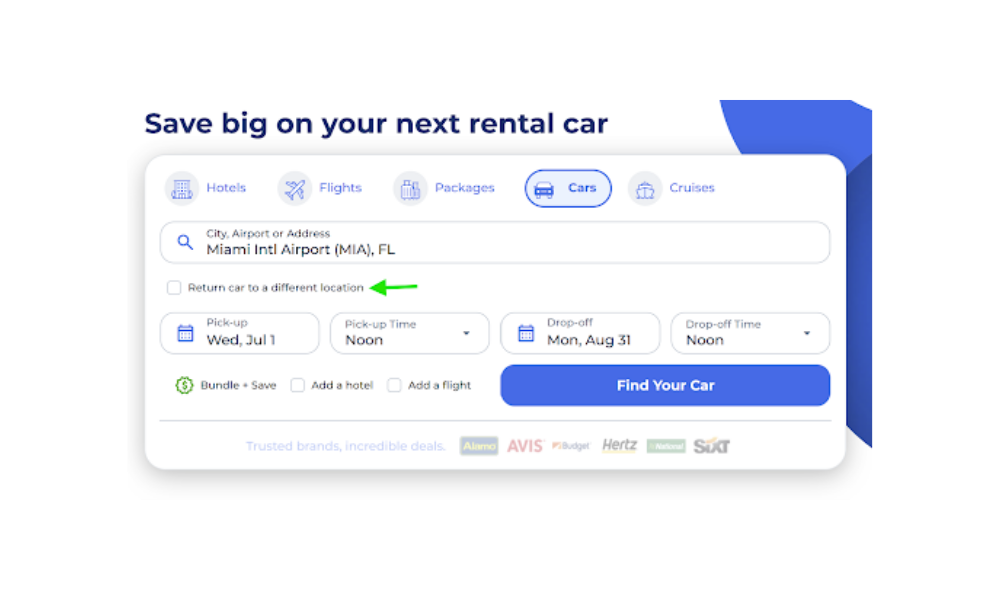
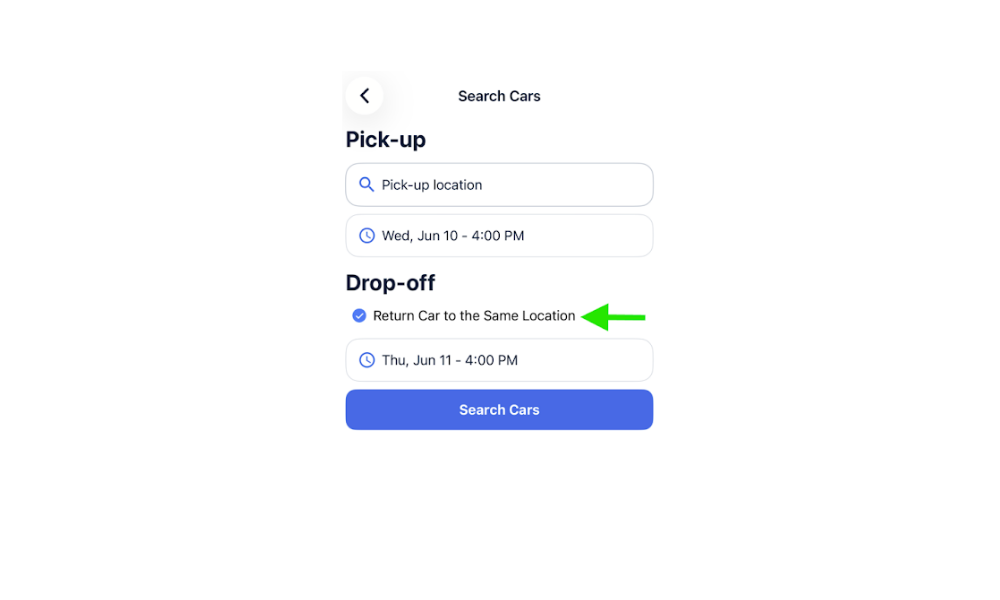
In the app, uncheck the option for “Return Car to the Same Location”
Many rental companies charge a one-way fee, sometimes called a drop fee. This fee helps offset the cost of relocating the vehicle back into the rental company's fleet network. The amount can vary depending on the pickup and drop-off locations.
Not all rental locations or vehicle types are eligible for one-way rentals. Availability often depends on fleet inventory, regional demand, and the rental company's policies.
One-way rentals are especially popular among travelers embarking on road trips, individuals moving to a new city, or anyone traveling between destinations without plans to return to their starting point.
The cost of a one-way rental can vary widely. In some cases, one-way rentals may be more expensive due to vehicle redistribution costs. In other situations, they can be surprisingly affordable if a rental company needs vehicles moved to a particular location.
If your travel plans involve multiple destinations or a one-directional journey, a one-way rental can provide convenience and flexibility that a traditional rental cannot. Before booking, it's a good idea to compare pricing, review any applicable fees, and confirm that your preferred vehicle is available for one-way travel.
For many travelers, the ability to start and end a trip in different locations makes a one-way rental a practical and stress-free transportation solution.
A rental car is not just another trip expense. It is one of the more flexible costs in the plan, which means it is one of the easiest places to save if you know where to look.
The travelers who spend less usually are not doing anything dramatic. They compare pickup locations. They stay realistic about vehicle size. They verify insurance before paying for more coverage than they need.
That is the whole game. Start with the right car, compare the right pickup spots, and make the extras prove their value.
Discover the smartest ways to build vacation packages. Our data reveals the exact departure days and booking windows to save up to 59% on your next trip.
Apr 22, 2026
Discover the cheapest days and months to book hotels. Save up to 29% on your next trip with our data-driven guide to domestic and international check-ins.
Mar 3, 2026
Learn the cheapest days and months to fly. Our data reveals when to book domestic and international flights to save up to 31% on your next trip.
Mar 3, 2026